
Types of PPF explained.
A car-care guide
The main types of PPF are easier to compare when you separate material, surface features and finish.
General guidance from 1.618 Dettagli Auto, Lajpat Nagar, New Delhi.
Defining the choice
Separate material from finish
Material tells you what the film is made from, while finish tells you how its surface is intended to look. Keep separate fields for the topcoat, thickness and installed coverage too. Read what paint protection film means for how the film sits over your paint.
TPU describes a material; gloss and matte describe appearance. Self-healing describes a surface feature. A film can have all three descriptions, so start with the exact product name.
Garware, LLumar and XPEL appear on our film list; current variants and availability belong in your proposal. At our Lajpat Nagar studio, you agree the film, finish and panels before work starts. Our PPF service covers that discussion.
A description such as matte TPU is therefore perfectly consistent. One word identifies the appearance and the other identifies the material. A clear quote gives you both, rather than expecting one appealing label to explain the whole product.
Know the material
TPU, TPH and PVC on a quote
TPU means thermoplastic polyurethane, while TPH and PVC labels need to be matched to the proposed product’s technical sheet. Base material is one field in the comparison, not the entire specification. Keep the manufacturer and exact variant beside it.
Request the manufacturer sheet matching the exact film on the quote. For a TPH-labelled alternative, identify the manufacturer and product first, then compare its stated construction and care instructions rather than relying on the label. With those documents, the material comparison can stay specific. There is no need to assign an assumed recipe or service life to an unidentified roll.
For a documented polyurethane example, 3M identifies the base film on its Scotchgard Pro Series page. Use the same level of detail for another proposed material. A generic brochure covering several products may need a matching variant sheet before the construction field is clear.
A useful side-by-side comparison starts with two named films, not two abbreviations. If one proposal includes only a material label, complete the product field first. You can then compare the appearance, surface features and written terms without guessing which roll the supplier means.
The same principle helps when a proposal changes during the discussion. Record the replacement product and check its own documents. Keeping the original finish or price does not tell you whether the base material and surface features have also stayed the same.
| Label | What it describes | What to record separately |
|---|---|---|
| TPU | Thermoplastic polyurethane | Product, finish, topcoat and thickness |
| TPH | Supplier’s material label; establish the formulation | Named maker and matching technical sheet |
| PVC | A base-material description to verify | Intended use and the product’s stated features |
| Gloss or matte | Visual appearance | Base material and installed coverage |
Reading the sheet
How to compare film thickness
Compare thickness using the same units and the same measurement basis for each named film. A quoted total may include layers that another document measures separately. Record whether adhesive is included before treating two figures as equivalent.
If one sheet uses microns and another uses mils, get the measurements presented consistently. The technical sheet is the reference, rather than how thick a loose sample feels. Keep finish, surface features and written terms alongside that number; thickness alone leaves much of the purchase undecided.
For two similar-looking samples, match each one to its product name before comparing specifications. That keeps the visual choice connected to the material you are actually considering. It also gives you a clear reference if the proposal later changes.
Product properties
Topcoat and self-healing
The topcoat is the film’s exposed surface, and self-healing means fine marks can fade with heat on products designed for it. XPEL describes heat-activated healing of minor scratches and swirl marks. Deep cuts, torn film and dents are outside that feature.
Water behaviour is another surface characteristic. A hydrophobic surface encourages water beading, but a water test does not identify the base material or brand. Read the feature against the exact product, and use a sample to understand its appearance.
A film with a built-in topcoat and a film sold with an additional coating are different proposals. For a combined package, identify the extra product, its purpose and compatibility. That makes it easier to decide whether the added treatment answers a priority of yours.
Your finish
Gloss, matte, satin and colour
Gloss, matte, satin and colour describe the visual result you want from the film. Garware’s range includes different finishes and coloured options, showing why a brand name alone leaves the appearance undecided. Start by saying whether you want to retain or change your current finish.
For matte and satin PPF, a sample on a relevant car colour is more useful than a bright reflection in a photograph. Our film list includes gloss, matte and black-gloss options.
For black or coloured film, write down the chosen product and panels. A black-painted car is not evidence of a black-film installation. Confirm applicable registration requirements for an intended colour change before agreeing the work.
Product conditions
Yellowing and warranty claims
Yellowing resistance describes a product feature, while warranty wording sets out the defects and conditions covered. Keep those fields separate when reading a brochure. The lifespan guide explains how warranty periods relate to care and the condition of installed film.
The applicable maker terms identify the issuer, territory, exclusions, remedy and any registration requirement. A listed period is not the full warranty and does not, on its own, describe fitting support.
A longer stated period is useful only when you understand what it covers. Compare the relevant documents rather than choosing from the largest number printed beside a product photograph. Keep those documents with the invoice for future reference.
Before booking
How to check the film before booking
Send your car model, preferred finish and the panels you want protected on WhatsApp.
Use the list below to keep two proposals on the same basis. If a product changes, update the relevant specification and care documents as well. This leaves you with a clear account of the selected film rather than a collection of unrelated brochure claims.
- Manufacturer and exact product or variant.
- Matching technical sheet, base material and finish.
- Thickness stated on a comparable measurement basis.
- Surface features belonging to that product.
- Covered panels, edge treatment and excluded surfaces.
- Product-warranty terms, care instructions and separate installation support.
A few answers
Questions before deciding
Is TPU a finish?
No. TPU means thermoplastic polyurethane. Gloss, matte or another appearance needs a separate description on the proposal.
Does TPH identify the exact material?
The named maker’s technical sheet is needed to establish the formulation. Keep that document attached to the proposed product.
Does thicker always mean better?
Thickness is one part of the choice. Compare its measurement basis alongside finish, surface features, written terms and installed coverage.
How do I compare self-healing films?
Compare the exact products, the surface marks described and the maker’s stated conditions. Match any sample demonstration to the proposed film.
Which types does the studio fit?
Our film list includes Garware Protect 200 microns, Garware Matte 210 microns, Garware Black Gloss 210 microns, LLumar Gloss 190 microns, XPEL Ultimate Plus 200 microns, XPEL Stealth 210 microns and XPEL Ultimate Plus Black 220 microns. Use the manufacturer sheet for the selected product to check its base material and construction. These details complete the local product choice.
Message the studio with your car model and the finish or work you want to discuss.
Studio visit
Prefer to see the options in person?
Arrange a studio visit. Talk through your questions about film, finish and coverage before deciding what suits your car.
C-32, Lajpat Nagar II, New Delhi 110024
Listed hours: daily, 10 am–9 pm.
Directions
Call the studio
Use WhatsApp to send your car model and preferred visit date.
Contact details & listed hours
Related reading: PPF service, PPF price guide, ceramic service.
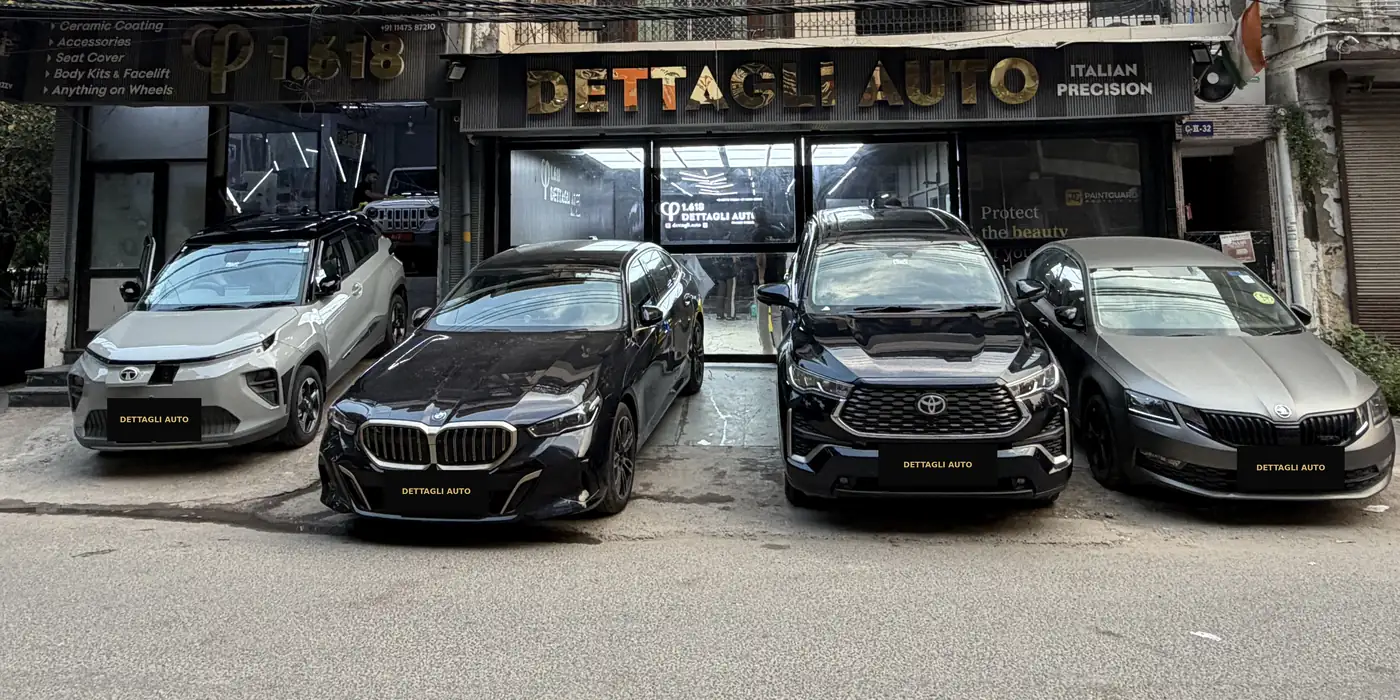
Photographed in our studio.